ServicesBattery Storage
Battery Storage in Dallas
A home battery stores solar power for outages and evening use. We size it from the circuits you actually need, explain kilowatt-hours versus kilowatts in plain terms, and install it so it stays cool, code-compliant and ready when the grid drops.
How a Home Battery Works and Who It Suits
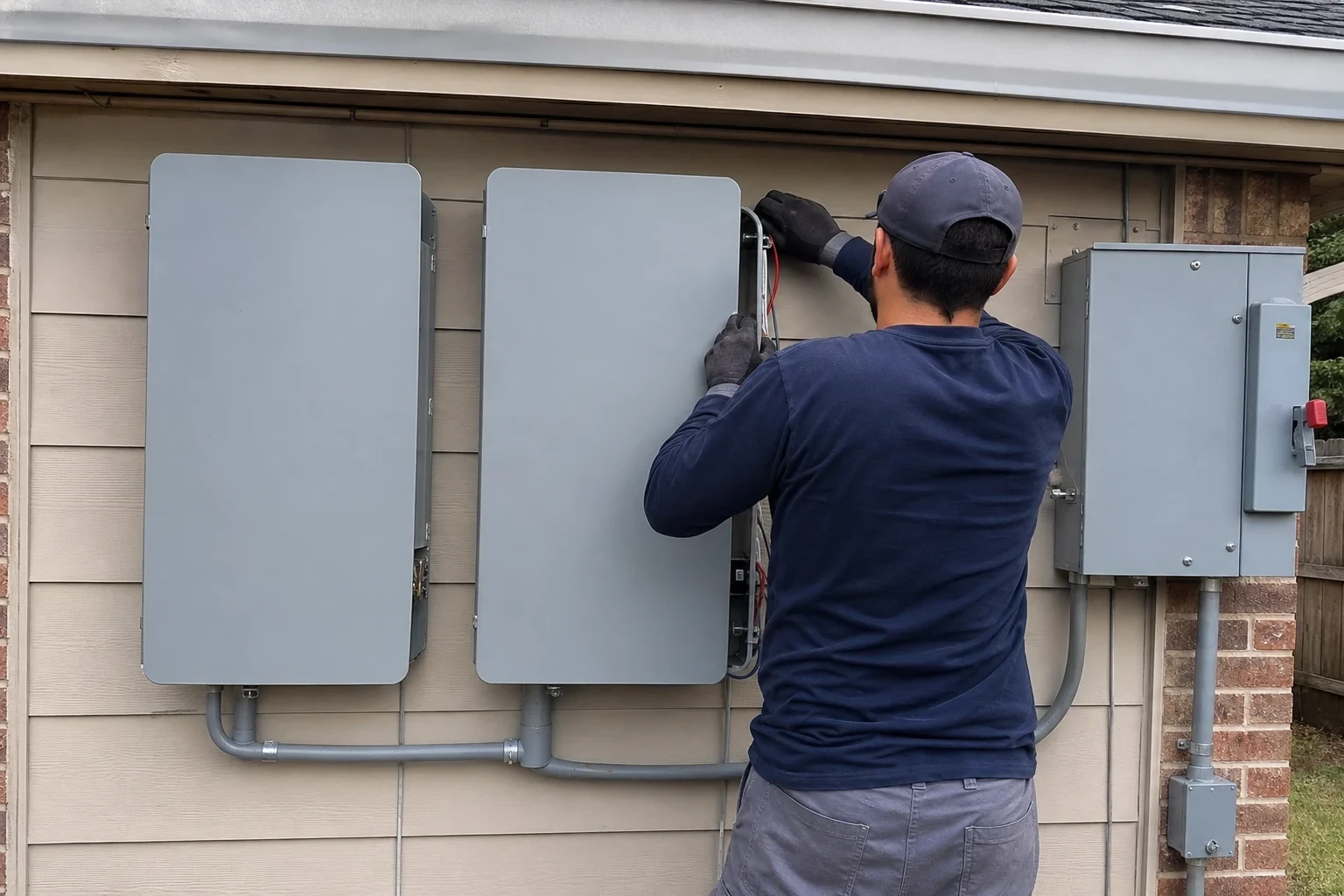
Three pieces do the work in a battery setup: the cabinet that holds the cells, an inverter that converts their stored DC into the AC power your outlets use, and a backup gateway or transfer switch that cuts your home off from the grid when the power fails. That cutoff is the key piece. Without it, your panels go dark during an outage, even under full afternoon sun.
A battery's limits come down to two ratings. Kilowatt-hours of capacity tell you how long it can keep going. Kilowatts of output tell you how many things it can power at the same moment. A unit can sit at full charge and still shut off when a big motor kicks on if its output is too low. We explain both ratings before you settle on a model.
Storage earns its place when outages worry you most, when your retail electric plan credits little for the solar you export, or when both are true. Dallas homeowners have asked about it often since the grid failure of February 2021, and the straight answer always comes back to your loads and your plan.
What Our Battery Installation Includes
Load review and sizing
We list the circuits you want powered during an outage, such as the refrigerator, sump pump, lights, internet and medical equipment, then size capacity and output to match. You see the math, not just a recommendation.
Critical-loads or whole-home setup
A critical-loads panel moves selected circuits onto backup and stretches a smaller battery further. Whole-home backup covers everything but needs more output and capacity. We explain what each choice means for runtime.
AC-coupled or DC-coupled design
If you already have solar, an AC-coupled battery usually adds on without replacing your inverter. New systems can use a hybrid inverter that charges the battery straight from the panels with fewer conversion losses.
Placement for heat and code
Lithium batteries lose capacity and age faster when they run hot, so we look for shaded exterior walls or a garage spot with airflow. Fire code also limits where a battery can mount and how much capacity can sit in one place, and we plan around both.
Permits and utility paperwork
We pull the electrical permit, schedule the inspection and handle the interconnection paperwork with your utility so the system can operate legally.
Setup and app walkthrough
We set backup reserve levels and charging behavior, then show you how to read the monitoring app.
Signs a Battery Belongs on Your List
Outages cost you something real
Spoiled food, a stopped sump pump or a home office going dark are concrete losses. A battery covers those circuits without a generator's fuel or noise.
Your buyback credit is low
Texas has no statewide net metering, so each retail electric provider sets its own export credit. If yours pays far less than you pay for grid power, storing midday solar for evening use keeps more of its value at home.
Someone at home relies on powered equipment
Oxygen concentrators, CPAP machines and refrigerated medication need steady power. These circuits are usually the first we put on backup.
Your solar goes dark in outages
If your panels stop producing when the grid fails, your system has no islanding capability. Adding a battery with a backup gateway changes that.
You are planning new solar anyway
Installing storage alongside new panels shares one permit, one inspection and one round of electrical work. Adding it later is possible but usually means a second visit and a second set of paperwork.
Steps in a Battery Installation
- 1
Opening phone call
We learn which circuits you want backed up, how long outages tend to last at your home and what solar equipment you already have. That narrows the options before we schedule a visit.
- 2
Site visit and panel review
We record your main panel's amp rating and open breaker slots, measure the wall where the battery could mount and check the sun and heat at each possible spot. An undersized or full main panel is the surprise we find most often, so we check it first.
- 3
Plan, estimate and permit
Your estimate lists the battery, inverter, gateway and any panel work as separate lines. Once you okay it on a call with us, we bring the plans to the city to get the electrical permit.
- 4
Install day
Most installs are done in one day. Power to the house is off for a few hours while we wire the gateway and move circuits, and we tell you that window before we arrive.
- 5
Inspection and first start
After the city inspection passes and the utility approves, we power up the system, run a test outage so you can see it switch over, and clean up the work area.
What Sets the Cost of a Home Battery
Two things drive most battery pricing: how much of the house you want covered and whether your electrical system is ready to take a battery. We price every job after the site visit and show each line, so no new charges turn up once work begins.
- Storage and power ratings
- Each added kilowatt-hour means more battery modules. Needing enough output to start big motors can call for a second unit even when one would hold enough energy.
- Selected circuits or the whole house
- Covering chosen circuits uses a smaller battery but requires a subpanel. Covering the whole home drops the subpanel and calls for more equipment.
- State of your main panel
- A main panel that is old or out of space may need upgrading, or a different way to connect, before a battery can hook in.
- The solar you already have
- Certain older inverters work well with an AC-coupled battery. Others call for another setup or a new inverter.
- Where the battery goes
- A long run of wire between the battery and the panel adds parts and labor, and a hot wall may mean picking another spot or adding shade.
Common Questions About Home Batteries
Something not covered here? (972) 573-4503
How long will a battery run my home?
It depends on what it is powering. Keeping just the refrigerator, lights, internet and a few outlets going makes a charge last far longer than running the entire house. With solar recharging it each day, a properly sized critical-loads system can carry those circuits through an outage of several days. We calculate runtime from your own circuit list.
Will a battery run my central air conditioner?
In some homes, yes. A compressor pulls a short surge of power when it starts, and the battery needs enough output to cover that surge. A soft-start device can reduce the surge in some cases. We check your unit's nameplate specs before we answer, because on a hot day an air conditioner can drain a small battery in a few hours.
Can I add a battery to my existing solar?
Usually, yes. An AC-coupled battery can typically be added to a current system while the panels and inverter stay where they are. We confirm by checking your inverter model and main panel at the site visit.
Does Texas heat shorten a battery's life?
Lithium cells age faster in heat, and summer pushes garage and exterior wall temperatures very high. That is why we look for shaded, ventilated locations and favor lithium iron phosphate batteries, which handle heat better than several other chemistries.
Is the battery installation under warranty?
Yes. The installation work we do falls under our 10-year workmanship warranty on solar. The battery itself has its own manufacturer warranty, and we go over those terms with you before you choose a model.
See What a Battery Could Keep Running in Your Home
Five years in business, BBB Accredited with an A+ rating. Call once and get a plain answer on battery size, where it would mount and whether storage belongs in your plan. We serve homes in Dallas, Irving, Garland and the towns around them.